

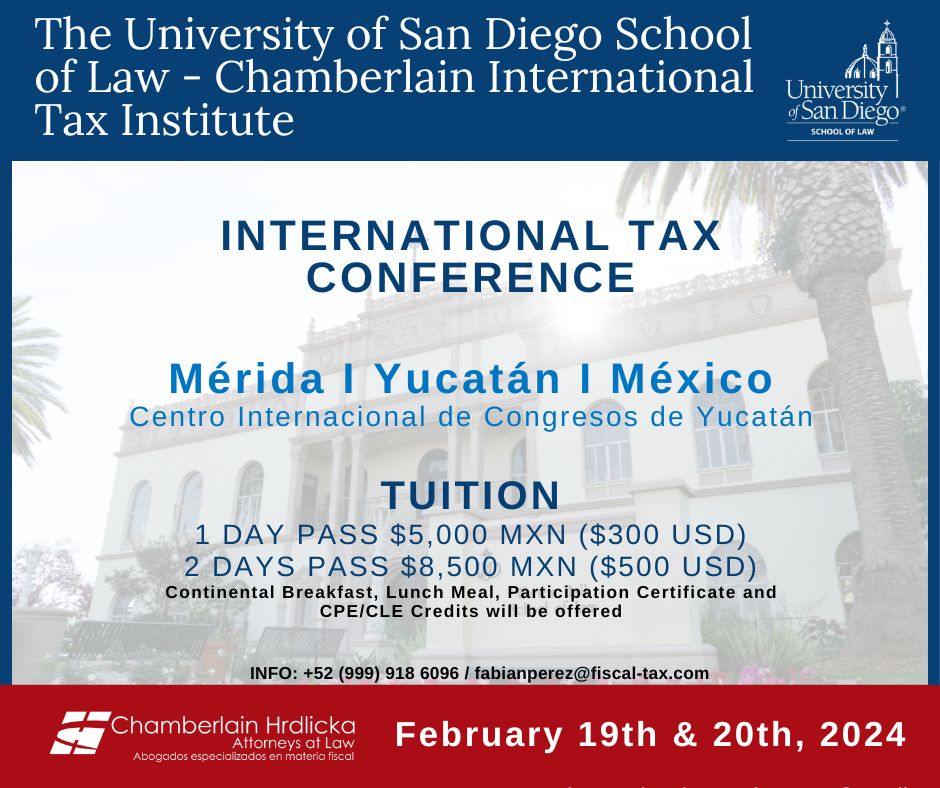
International Tax Conference in Mérida, Yucatán, México on February 19th and 20th, 2024
The University of San Diego School of Law – Chamberlain International Tax Institute is approaching quickly! The event will take place on February 19th and 20th, 2024 at the newest International Convention Center in Mérida, México and this event will highlight an all-new and exciting agenda:
AGENDA:
Monday February 19th, 2024
- Registration & Coffee with Sweetbread: 7:30 a.m. – 8:30 a.m.
- Openin Remarks: 8:40 a.m. – 8:50 a.m.
- Robert Schapiro, Dean University of San Diego School of Law
- Patrick Martin, Chamberlain Hrdlicka (San Antonio)
- Karen Sigmond, University of San Diego School of Law
- 9:00 a.m. – 10:00 a.m.
Panel 1-A: United States-based Cross-Border Real Estate Investments (Advanced) - Description: In this panel, speakers will analyze the fiscal effects in the U.S. arising from real estate investments by foreign (non-US) investors. They will cover advanced planning alternatives and considerations when choosing the appropriate real estate investment mechanism. Specific tax treaty rules will be considered along with tax-exempt portfolio interest rules that exist in the United States. Earnings stripping rules and thin capitalization requirements will be analyzed. From the Mexican fiscal perspective, speakers will analyze the fiscal consequences of real estate investments in the U.S. by Mexican residents, whether through transparent, legally separate companies, such as C corporations or hybrid legal entities. Specific withholding tax considerations will be discussed from both countries including taxes upon exit.
- John Merrick, IRS Office of the Associate Chief Counsel, International (Washington DC)
- Patrick W. Martin, Chamberlain Hrdlicka (San Antonio)
- Luis Gerardo del Valle Torres, Jaureguí y Del Valle (Mexico City)
- Panel 1-B: International Tax Reporting: New Reporting of International Partnerships – K-2s & K-3s
- Description: In this panel, speakers will analyze the basic tax treatment in the U.S. and Mexico resulting from investments made through fiscally transparent entities. They will emphasize the various international information tax reporting rules, including the new K-2 and K-3 formats related to internationally reportable aspects by fiscally transparent U.S. entities. From the Mexican perspective, speakers will analyze the substantive tax effects and informational nature derived from foreign investments made through transparent legal entities according to Articles 4-A and 4-B of the Income Tax Law.
- Samanta Guerra, Sol Schwartz (San Antonio)
- Luz Villegas, Chamberlain Hrdlicka (San Antonio)
- Jesús Alvarado Nieto, Crowe-Gossler (Mexico City)
- 10:10 a.m. – 11:10 a.m.
Panel 2-A: Embracing and Transforming Taxation through GenAI: The Future of Professional Services - Description: Our panelists will introduce tax experts into the dynamic realm of generative artificial intelligence and its pivotal role in revolutionizing tax practices. Our seasoned panelists will collectively unravel the potential of generative AI, showcasing how it can be harnessed to refine and elevate end-to-end tax processes. They will forecast the evolution of automated services to the strategic deployment of AI in complex tax planning and decision-making scenarios. The panelists will outline the potential applications of AI in tax, from generating accurate tax documents to conducting predictive audits and beyond. They will also discuss the importance of staying abreast with this technology to maintain competitive advantage and operational efficiency. Moreover, our experts will highlight the risks of ignoring the rise of AI in tax, emphasizing the necessity for the industry to adapt. The conversation will be grounded in practical advice and actionable insights for integrating AI into tax practices. Attendees can look forward to a straightforward, no-frills discussion that aims to demystify AI and offer clear, actionable strategies for its adoption in tax-related fields.
- Adrián Guarneros, Ernst & Young (Mexico City)
- Andrés Fuentes, Ernst & Young (Mexico City)
- Roberto Pérez Teuffer, Chamberlain Hrdlicka (San Antonio)
- Panel 2-B: U.S. Investor Visa Options and Limitations
- Description:The speakers will analyze the different types of investment visas available in the US, as well as the fiscal consequences associated with them. Tax consequences will go beyond tax residency, and will consider the type of future ad ongoing tax compliance obligations individuals will have depending upon their immigration status and physical presence in and out of the United States. A discussion of recent case law will be included, specifically federal court decisions, favorable to non-US citizens. This will include a very brief discussion of pre-immigration planning alternatives from both the Mexican fiscal perspective (when changing residence for tax purposes) and the U.S. perspective (when becoming a resident for tax purposes in the U.S.). Discussion of international tax consequences to family members will be included, including community property versus separate property ownership.
- Ana Victoria Pérez, Vialto Partners (Dallas, Texas)
- Juan Vásquez Jr., Chamberlain Hrdlicka (Houston)
- Anuar Estefan, Chamberlain Hrdlicka (San Antonio)
11:10 a.m. – 11:30 a.m. – Break
- 11:30 a.m. – 12:20 p.m.
Panel 3-A: International Tax Advisors: How to – “Go directly to Jail, Do Not Pass “GO”, Do Not Collect $200!” - Description: In this panel, speakers will analyze, from the US tax perspective, the civil and criminal liability of international tax advisors in the context of cross-border operations. They will discuss the limits of legitimate tax planning compared to assistance in fraudulent tax evasion schemes through practical cases. What legal theories governments can employ, and specifically what the US federal government has employed in cases that are designed to defraud governments of taxes owed; particularly when opaque legal structures are developed to hide the taxable income. The panel will discuss red flags and fact scenarios to be aware of that could give rise to criminal exposure. The focus will be on advisers who cross the line and run the risk of “going directly to jail.” Some specific cases will be discussed.
- John Kucera, Boies, Schiller, Flexner LLP (Los Angeles)
- Benjamin Eisenstat, Caplin & Drysdale (Washington D.C.)
- Ambrosio Michel, Michel Abogados (Mexico City)
- Panel 3-B: California, Texas & Florida Probate Proceedings of Cross-Border Estates
- Description: The speakers will analyze the rules inherent in testamentary and intestate succession procedures in multiple jurisdictions, including California, Texas, Florida, and Mexico, in the context of bi-national families and assets. Specific discussion will be made about tax reporting that will be required of the executors of cross-border estates, and how, and when asset information is made public through the US probate courts. They will provide recommendations and planning alternatives through wills, and other testamentary instruments commonly employed in the United States, such as common law trusts.
- Verónica Vásquez, Bexar County Probate Court Judge
- George Metcalfe, Gunster (Miami)
- James J. Brown, Goodwin, Brown, Gross & Lovelace LLP (San Diego)
- Luz Villegas-Banuelos, Chamberlain Hrdlicka (San Antonio)
- Consuelo Visoso Lomelín, Notarías Visos (Mexico City)
- 12:30 p.m. – 13:20
Panel 4-A: United States Supreme Court – Tax Decisions & Moore - Description: In this panel, the speakers will cover the active role the United States Supreme Court has taken recently, in reviewing a range of tax and tax-related cases. Specifically, internationally impacted cases. The aspects concerning the constitutionality of international tax laws will be discussed, including a renowned tax scholar, with a particular emphasis on the Moore v. United States case. They will discuss its impact on multiple areas in the fiscal agenda of legislative bodies worldwide, including strengthening anti-deferral regimes, taxes on unrealized gains, and wealth taxes.
- Bret Wells, University of Houston Law Center (Houston)
- Justicia David M. Medina, Chamberlain Hrdlicka (Houston & San Antonio)
- Victor Jaramillo, Caplin & Drysdale (Washington D.C.)
- Panel 4-B: Avoiding Estate Taxes on U.S. – “Situs” Assets (risks in the Bolsa and opportunities)
- Description: In this panel, experts will analyze general aspects regarding the U.S. estate and gift tax, as well as alternatives and planning opportunities available for investments in debt and equity instruments of U.S. issuers by Mexican tax residents. Particular focus will be on Mexican publicly traded shares of United States companies. What are the United States estate tax consequences and the tools the US federal government has at its disposal so identify estate taxes that are due but where no tax returns have ever been filed
- Patrick W. Martin, Chamberlain Hrdlicka (San Antonio)
- Raúl Navarro, Chevez, Ruiz, Zamarripa (Houston, Mexico City)
- Tania Albuja, Chamberlain Hrdlicka (Houston)
13:30 – 14:50: Lunch
- 15:00 – 16:00
Panel 5-A: Aroeste v. the United States: Limits on Government Authority Re: Tax Treaty Law - Description: In this panel, speakers will analyze the recent case of Aroeste v. United States. They will emphasize the application of residency tie-breaker rules for tax purposes in accordance with the US-Mexico tax treaty. A host of consequences that flow from this decision will be considered, including IRS notice 2018–95; and what penalty might apply for late filed treaty positions. Importantly, discussions about invalid tax returns that might’ve previously been filed or no filing of returns will be considered; including the timing of specific tax treaty consequences. In addition, the broad impact to tax administration, tax advisers to individuals who have their green card status, and how, and when their tax residency should reported to the Internal Revenue Service will be explored. They will also discuss the limits imposed by the courts on the US tax authority in applying fines for the omission of international information reports.
- Bret Wells, University of Houston Law Center (Houston)
- Michael J. Miller, Roberts and Holland LLP (New York City)
- Michael J.A. Karlin, Karlin & Peebels, LLP (Los Angeles)
- Leo Unzeitig, Chamberlain Hrdlicka (San Antonio)
- Panel 5-B: Attorney-Client Privilege and Confidentiality Limitations in International Tax Matters: In Re Grand Jury, Taylor Lohmeyer and more
- Description: This panel will focus on the limits of attorney-client privilege, confidentiality, and how governments can effectively collect information on global taxpayers and individuals, even when they have not been specifically identified in a tax audit. What tools have governments used in collecting these records, including from law firms, accounting firms, financial advisors, and third parties beyond the taxpayers themselves criminal law experts, who previously served as prosecuting attorneys will explain some of the practical limitations and what steps would often be advisable regarding advice, provided to cross border taxpayers in delicate transactions, or previously filed false information, documents, or even false tax returns.
- Evan J. Davis, Hocham, Salkin, Toscher, Perez P.C. (Los Angeles)
- Gabriela Pellón, Galicia Abogados (Mexico City)
- Jeremy Temkin, Morvillo, Abramowitz, Grand Iason & Anello PC (New York City)
- Jaime Vásquez, Chamberlain Hrdlicka (San Antonio)
- 16:10 – 17:10
Panel 6-A: Corporate Transparency Act/anti-money-laundering FinCEN Reporting - Description: This panel will analyze, from a comparative perspective, the new Corporate Transparency Act and obligations regarding the identification of controlling beneficiaries in Mexico. New regulations and new reporting requirements have now taken affect in the United States imposing in some cases severe penalties for Mexican and other non-US owners who have interest in US legal entities. The panel will discuss the application of these rules and how and where reporting must take place through the United States, Treasury Department, FinCEN. It will cover their main differences between both countries and implications in a cross-border business environment.
- Angélica Ortiz Dorantes, Ortiz y Asociados S.C. (Mexico City)
- Mae Lew, IRS Office of the Associate Chief Counsel, International (Washington DC)
- Luz Villegas-Banuelos, Chamberlain Hrdlicka (San Antonio)
- Panel 6-B: Cross-Border Aircraft Acquisitions, Financing and Leasing; Taxes, Aircraft Registration & Permitting
- Description: In this panel, our experts will analyze the most common business and estate structures for the acquisition, financing, and leasing of aircraft in the Mexico-U.S. cross-border context. What are the licensing and operating requirements and practical administration and accounting for costs. They will discuss best practices and tax planning opportunities.
- Katie Deluca, Harper Meyer (Miami)
- Angel Houck, Houck & Christensen (Orlando, Florida & Casper, Wyoming)
- Carlos Sierra, Abogados Sierra S.C. (Mexico City)
- 6:00 p.m. – 8:00 p.m.
Cocktail Reception at Museum Palacio Cantón in Mérida.
FIRST DAY END
AGENDA
Tuesday, February 20th, 2024
- 8:00 a.m. – 8:50 a.m. – Breakfast
- 9:00 a.m. – 9:50 a.m.
Panel 7-A: Latest Developments in International Corporate Reorganizations - Description: In this panel, speakers will analyze innovative aspects regarding international corporate reorganizations through practical cases. They will cover requirements for exemption or deferral of income tax in the US due to a corporate reorganization, as well as the repatriation of intangible assets. From the Mexican fiscal perspective, experts will analyze the main mechanisms for corporate reorganization established in the Income Tax Law.
- Michael Lebovitz, Eversheds Sutherland LLP (San Francisco)
- John Merrick, IRS Office of the Associate Chief Counsel, International (Washington D.C.)
- Carlos Martínez, White & Case (Mexico City)
- Elena Robles, Estafeta (Mexico City)
- Panel 7-B: Pitfalls of International Trusts with U.S. Beneficiaries (in a high-interest rate environment)
- Description: Our experts will analyze how, in a high-interest context, transferring assets to a foreign trust in jurisdictions like Switzerland or New Zealand can have a high fiscal cost for beneficiaries with U.S. nationality or residency. They will discuss planning alternatives to correct this type of highly inefficient estate planning from a fiscal perspective.
- Sarah Stein, IRS Office of the Associate Chief Counsel, International (Washington D.C.)
- Eugenio Grageda, Holland & Knight (Mexico City)
- Patrick W. Martin, Chamberlain Hrdlicka (San Antonio)
- 10:00 a.m. – 10:50 a.m.
Panel 8-A: EB-5 Visa Requirements and Tax Implications - Description: In this panel, the immigration law experts will analyze the requirements for the U.S. EB-5 visa, as well as recommendations from financial, fiscal, and migratory perspectives. How minor children can benefit from the visa and residency status of their parent, depending upon their plans to stay, or return to the country of origin will be discussed. Going full circle, a discussion will include the consequences if the investor later decides to formally abandon their lawful permanent residency (or simply apply for a tax treaty residency position) or renounce United States citizenship if they obtain it through the process of the EB5. A detailed discussion of US international tax consequences, particularly including covered bequests and covered gifts once people decide to leave, the United States will be analyzed. Some of the possible criminal exposure items will be addressed by a criminal expert, including what happens when false statements are included in forms, presented to the federal government, specifically, including tax return expatriation forms. They will discuss what should be done, what to avoid, and warning points.
- Michael Liberatore, Michael J. Liberatore Law Firm (Miami)
- Patrick W. Martin, Chamberlain Hrdlicka (San Antonio)
- Jeremy Temkin, Morvillo, Abramowitz, Grand Iason & Anello PC (New York)
- Panel 8-B: Expiring TCJA International Tax Provisions: 2025 Soon Upon Us
- Description: In this panel, speakers will analyze the legislative changes incorporated into U.S. tax legislation in 2017 through the Tax Cuts & Jobs Act and its expiration in 2025. They will cover the most relevant ones in international tax matters for Mexican investors, such as the effective rate for intangible income, bonus depreciation, and the exemption of over $13 million in a lifetime, exclusion amounts for United States, citizens and US domicile individuals.
- Victor Jaramillo, Caplin & Drysdale (Washington D.C.)
- Sebastien Chain, Chamberlain Hrdlicka (Houston)
10:50 a.m. – 11:15 a.m.: Coffee Break
- 11:15 a.m. – 12:05 p.m.
Panel 9-A: Tax Treaty Interpretation: Do They Mean What They Say (e.g Malta Pension Plans) - Description: In this panel, our experts will analyze the rules established by tax authorities and courts regarding the interpretation of tax treaties. They will discuss recent cases related to the application of treaties in circumstances unforeseen by participating countries, resulting in double non-taxation. In the case of the US, speakers will analyze the tax strategies of contributing to Malta pension plans and the risks imposed now that they have been identified negatively by the Internal Revenue Service
- Sarah Stein, IRS Office of the Associate Chief Counsel, International (Washington D.C.)
- Michael J. Miller, Roberts & Holland LLP (New York City)
- Tom Cullinan, Chamberlain Hrdlicka (Atlanta)
- Alejandro Calderón, Calderón, González y Asociados (Mexico City)
- Panel 9-B: Check the Box Planning Including Pre-Immigration (Asset Planning – + International Companies)
- Description: In this panel, speakers will analyze pre-migration tax planning mechanisms in the U.S. for individuals owning foreign companies and real estate. This will include a tax election (check-the-box election) for foreign companies classified as fiscally transparent entities before changing tax residency. From the Mexican fiscal perspective, speakers will analyze the mechanism and updates associated with filing the notice of change of tax residence in Mexico.
- José Alberto Mesta, Chevez, Ruiz, Zamarripa (Mexico City)
- Patrick W. Martin, Chamberlain Hrdlicka (San Antonio)
- Luciana Zamith Fischer, Hunter, Taubman, Fischer & Li LLC (Miami)
- 12:15 p.m. – 13:05
Panel 10-A: Pillar 2 in Effect: First Qtr. 2024 Planning & Compliance + Pillar 1 with Public Comments – December 11th, 2023 - Description: In this panel, speakers will offer a general perspective on the BEPS 2.0 Plan, Pillars 1 and 2, as well as the challenges associated with its implementation in the U.S. and Mexico. The US treasury regulations will be discussed and the practical impact to Advisors who are advising clients under these international business operations. They will discuss practical obstacles and reflections on the required legislative consensus.
- Bret Wells, University of Houston Law Center (Hosuton)
- Raúl Navarro, Chevez, Ruiz, Zamarripa (Houston and Mexico City)
- Marcus Heyland, KPMG (California-Washington D.C.)
- Panel 10-B: Tax and IP Considerations for US-Mexico Cross-Border Transactions
- Description: This panel will focus on common types of intellectual property ownership and licensing mechanisms and discuss U.S. and Mexico, tax and IP issues associated with the same, including economic ownership, cost sharing, eligibility of FDII, withholding taxes, etc. How Mexico looks at the use of intellectual property that’s based outside of the country; in special rules that can apply beyond tax treaty reduced rates.
- Gloria Niembro, Chevez, Ruiz, Zamarripa (Mexico City)
- Aly Dossa, Chamberlain Hrdlicka (Houston)
- Sebastien Chain, Chamberlain Hrdlicka (Houston)
- 13:15 p.m. – 14:15 p.m.
Panel 5: International IRS & SAT Collection Enforcement – (cross-border tax judgments and liens) - Description: In this panel, our experts from the U.S. and Mexico will analyze the collection mechanisms available to tax authorities of both countries for identifying taxpayers and collecting tax credits in cases of taxpayers with assets in both countries. The limitations exist when there is no specific treaty mechanism to enforce tax obligations from one country into another country. How information is collected, and how assets themselves might be subject to liens and levees in favor of government agencies. A discussion of the statute of limitations will be analyzed, particularly when taxpayers are outside of the country for periods. Private practitioners will discuss what kind of legal theories or legal defenses could be available for a delinquent taxpayer; including ethical considerations and potential risks of fraudulent transfers
- Mae Lew, IRS Office of the Associate Chief Counsel, International (Washington D.C.)
- Leo Unzeitig, Chamberlain Hrdlicka (San Antonio)
- Daniel Price, Law Offices of Daniel N. Price, PLLC (San Antonio)
CONFERENCE END


 The University of San Diego School of Law - Chamberlain International Tax Institute